
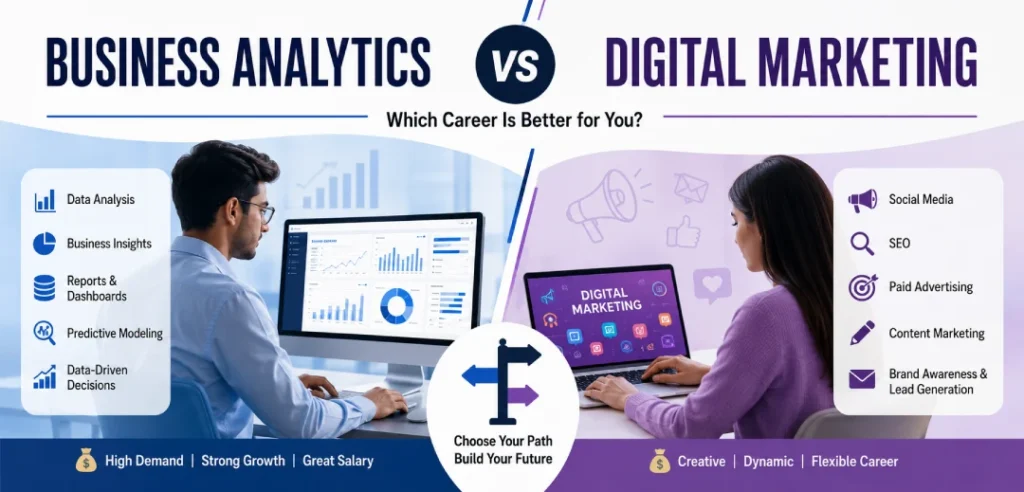
The modern job market is increasingly driven by data, technology, and digital transformation. As businesses compete to attract customers and make smarter decisions, two career paths have emerged as highly sought-after options: Business Analytics and Digital Marketing.
Students, MBA graduates, and working professionals often find themselves comparing Business Analytics vs Digital Marketing when choosing a specialization or planning a career switch. Both fields offer excellent growth opportunities, attractive salaries, and strong demand across industries. However, they differ significantly in terms of skills, daily responsibilities, career progression, and earning potential.
While Business Analytics focuses on transforming data into actionable business insights, Digital Marketing revolves around promoting products, services, and brands through digital channels. The choice between the two depends largely on your interests, strengths, and long-term career goals.
In this guide, we will compare Business Analytics vs Digital Marketing in detail, including job roles, required skills, salary expectations, future scope, and career growth opportunities. By the end, you’ll have a clear understanding of which field is the better fit for you.
Table of Contents
What Is Business Analytics?
Business Analytics is the process of using data, statistical methods, and technology to identify trends, solve business problems, and support decision-making.
Organizations generate massive amounts of data every day. Business analysts help companies understand this data and use it to improve operations, increase profitability, and gain a competitive advantage.
Key Responsibilities of a Business Analyst
- Collecting and analyzing business data
- Creating reports and dashboards
- Identifying trends and patterns
- Forecasting future outcomes
- Supporting strategic decision-making
- Improving business processes
Skills Required for Business Analytics
Technical Skills
- SQL
- Excel
- Power BI
- Tableau
- Python
- Statistics
- Data Visualization
Soft Skills
- Critical Thinking
- Problem-Solving
- Communication
- Presentation Skills
- Business Understanding
What Is Digital Marketing?
Digital Marketing refers to promoting products, services, or brands using online channels such as search engines, social media platforms, websites, and email.
As businesses shift their focus toward online customer acquisition, digital marketing professionals have become essential for driving traffic, generating leads, and increasing sales.
Key Responsibilities of a Digital Marketer
- Search Engine Optimization (SEO)
- Social Media Marketing
- Content Marketing
- Email Marketing
- Paid Advertising (PPC)
- Marketing Analytics
- Conversion Optimization
Skills Required for Digital Marketing
Technical Skills
- SEO
- Google Ads
- Meta Ads
- Google Analytics
- Content Marketing
- Marketing Automation
Soft Skills
- Creativity
- Communication
- Copywriting
- Strategic Thinking
- Customer Understanding
Business Analytics vs Digital Marketing: Key Differences
| Parameter | Business Analytics | Digital Marketing |
|---|---|---|
| Primary Focus | Data-driven decision making | Customer acquisition and brand growth |
| Nature of Work | Analytical | Creative and Analytical |
| Technical Skills | High | Moderate |
| Coding Requirement | Often Required | Usually Not Required |
| Tools Used | SQL, Tableau, Power BI, Python | Google Ads, Analytics, SEO Tools |
| Career Path | Data & Analytics | Marketing & Growth |
| Creativity Level | Low to Moderate | High |
| Demand | Very High | Very High |
| Salary Potential | Higher in senior roles | Strong growth potential |
| Learning Curve | Moderate to Difficult | Easier to Start |
Digital Marketing vs Business Analytics Salary Comparison
One of the biggest deciding factors for students is salary.
Let’s compare digital marketing vs business analytics salary across different experience levels.
Fresher Salary Comparison
Business Analytics
Fresh graduates entering analytics roles generally earn:
- ₹5 LPA to ₹10 LPA
Digital Marketing
Fresh digital marketers typically earn:
- ₹3 LPA to ₹6 LPA
Verdict
Business Analytics generally offers higher starting salaries.
Mid-Level Salary (3–7 Years)
Business Analytics
- ₹10 LPA to ₹20 LPA
Digital Marketing
- ₹8 LPA to ₹18 LPA
Professionals who specialize in performance marketing or growth marketing can earn salaries comparable to analytics professionals.
Senior-Level Salary (8+ Years)
Business Analytics
Roles include:
- Analytics Manager
- Senior Business Analyst
- Data Strategy Lead
Salary Range:
- ₹20 LPA to ₹50+ LPA
Digital Marketing
Roles include:
- Marketing Manager
- Growth Head
- Digital Marketing Director
Salary Range:
- ₹18 LPA to ₹45+ LPA
Salary Comparison Table
| Experience Level | Business Analytics | Digital Marketing |
|---|---|---|
| Fresher | ₹5–10 LPA | ₹3–6 LPA |
| Mid-Level | ₹10–20 LPA | ₹8–18 LPA |
| Senior Level | ₹20–50+ LPA | ₹18–45+ LPA |
Winner: Business Analytics
From a pure compensation perspective, Business Analytics generally has a slight advantage.
Career Growth in Business Analytics
Business Analytics offers a structured career progression.
Typical Career Path
Entry-Level
- Junior Analyst
- Data Analyst
- Reporting Analyst
Mid-Level
- Business Analyst
- Analytics Consultant
- BI Developer
Senior-Level
- Analytics Manager
- Head of Analytics
- Director of Analytics
Executive-Level
- Chief Data Officer
- Chief Analytics Officer
The increasing importance of data makes analytics professionals valuable across industries.
Career Growth in Digital Marketing
Digital Marketing offers diverse career opportunities with multiple specialization paths.
Typical Career Path
Entry-Level
- SEO Executive
- Social Media Executive
- Content Marketing Executive
Mid-Level
Digital Marketing Specialist
Performance Marketer
Growth Marketer
Senior-Level
Digital Marketing Manager
Marketing Strategist
Growth Manager
Executive-Level
- Marketing Director
- VP Marketing
- Chief Marketing Officer (CMO)
Digital marketing often rewards creativity and measurable results.
Future Scope of Business Analytics
The future of Business Analytics is extremely promising.
Reasons for Growth
- Data Explosion: Organizations generate vast amounts of information daily.
- AI Adoption: Artificial intelligence relies heavily on analytics and data interpretation.
- Business Intelligence: Companies increasingly use dashboards and predictive analytics for decision-making.
Emerging Opportunities
- Data Science
- Predictive Analytics
- Machine Learning
- AI Analytics
- Business Intelligence
Industry experts consistently rank analytics among the fastest-growing career fields globally.
Future Scope of Digital Marketing
Digital Marketing continues to expand as online business grows.
Reasons for Growth
- E-Commerce Expansion: More businesses are selling online.
- Digital Advertising Growth: Companies continue increasing digital ad budgets.
- Consumer Behavior Changes: Customers research and purchase products online.
Emerging Opportunities
- Performance Marketing
- Growth Marketing
- Influencer Marketing
- Marketing Automation
- AI-Powered Marketing
Digital marketing remains one of the most dynamic and evolving industries.
Which Is Easier to Learn?
Business Analytics Learning Curve
Business Analytics requires:
- Data interpretation
- Statistics
- Analytical thinking
- Technical tools
Many learners find analytics challenging initially because of its quantitative nature.
Difficulty Level
Moderate to High
Digital Marketing Learning Curve
Digital marketing is generally easier to enter.
You can start learning:
- SEO
- Content Marketing
- Social Media Marketing
without advanced technical knowledge.
Difficulty Level
Beginner to Intermediate
Winner
If you’re looking for a faster entry into the workforce, Digital Marketing is generally easier to learn.
Which Career Is Better for Different Types of Students?
Choose Business Analytics If:
You enjoy:
- Numbers
- Data
- Statistics
- Problem-solving
- Logical thinking
Ideal backgrounds:
- Engineering
- Mathematics
- Computer Science
- Statistics
Choose Digital Marketing If:
You enjoy:
- Creativity
- Communication
- Branding
- Consumer Psychology
- Content Creation
Ideal backgrounds:
- Commerce
- Business
- Arts
- Mass Communication
Best Courses for Business Analytics
1. Google Data Analytics Certificate
Covers:
- Data cleaning
- Visualization
- Analytics foundations
2. Power BI Certification
Focuses on dashboard development and reporting.
3. Tableau Certification
Widely used for business intelligence.
4. Advanced Business Analytics Programs
Ideal for professionals seeking career advancement.
Best Courses for Digital Marketing
1. Google Digital Marketing Certification
Excellent beginner course.
2. SEO Certification
Focuses on search engine optimization.
3. Meta Marketing Certification
Specializes in Facebook and Instagram advertising.
4. Performance Marketing Programs
Designed for professionals managing ad campaigns.
Business Analytics vs Digital Marketing for MBA Students
MBA graduates frequently choose between these specializations.
Business Analytics Advantages
- Higher salary potential
- Strong demand
- Strategic decision-making role
Digital Marketing Advantages
- Creative career opportunities
- Leadership potential
- Entrepreneurial benefits
For MBA graduates interested in leadership roles, both paths offer excellent opportunities.
Pros and Cons of Business Analytics
Pros
- High salary potential
- Strong demand
- Data-driven decision-making roles
- Excellent future scope
Cons
- Requires technical skills
- Learning curve can be steep
- Often involves extensive data work
Pros and Cons of Digital Marketing
Pros
- Easier entry
- Creative work environment
- Freelancing opportunities
- Entrepreneur-friendly
Cons
- Rapidly changing landscape
- Constant skill updates required
- Performance pressure
Real-World Career Scenarios
Scenario 1: Engineering Graduate
An engineering graduate with strong analytical skills may thrive in Business Analytics.
Recommended Choice
Business Analytics
Scenario 2: Commerce Student
A commerce student interested in branding and customer behavior may find Digital Marketing more engaging.
Recommended Choice
Digital Marketing
Scenario 3: Career Switcher
A professional looking for a quick transition into a growing industry may prefer Digital Marketing due to its lower technical barrier.
Recommended Choice
Digital Marketing
Scenario 4: Data-Oriented Professional
Someone who enjoys working with dashboards, reports, and business insights may excel in Business Analytics.
Recommended Choice
Business Analytics
Final Comparison Summary
| Factor | Business Analytics | Digital Marketing |
|---|---|---|
| Salary | Higher | Moderate to High |
| Creativity | Moderate | High |
| Technical Skills | High | Moderate |
| Job Demand | Very High | Very High |
| Future Scope | Excellent | Excellent |
| Learning Difficulty | Higher | Lower |
| Remote Work | Good | Excellent |
| Freelancing | Limited | Extensive |
| Entrepreneurship | Moderate | High |
FAQs
Business Analytics vs Digital Marketing: Which pays more?
Business Analytics generally offers higher average salaries, especially at mid and senior levels.
Is Business Analytics harder than Digital Marketing?
Yes. Business Analytics usually requires stronger analytical and technical skills.
Can I switch from Digital Marketing to Business Analytics?
Yes, but you’ll need to learn analytics tools, statistics, and data visualization.
Which has better future scope?
Both have strong future demand, but Business Analytics may benefit more from increasing data-driven decision-making.
Is coding required in Business Analytics?
Basic coding knowledge in SQL or Python is often beneficial.
Is coding required in Digital Marketing?
No. Most digital marketing roles do not require coding.
Which field is more suitable for MBA graduates?
Both are excellent. Choose Analytics for data-driven leadership and Marketing for brand and growth leadership.
Which field offers more freelancing opportunities?
Digital Marketing offers significantly more freelancing and consulting opportunities.
Which career is more AI-proof?
Both fields are evolving with AI, but professionals who can effectively use AI tools will remain valuable.
Which field is better for freshers?
Digital Marketing is generally easier to enter, while Business Analytics offers higher starting salaries.
Conclusion
When comparing Business Analytics vs Digital Marketing, there is no universal winner. The best choice depends on your interests, skills, and career aspirations.
If you enjoy working with data, solving business problems, and making strategic decisions, Business Analytics is likely the better fit. It offers higher average salaries, strong demand, and excellent long-term growth.
If you are creative, enjoy communication, and want to help brands grow online, Digital Marketing can provide a dynamic and rewarding career path with abundant opportunities for freelancing, entrepreneurship, and leadership.
In the debate of digital marketing vs business analytics salary, Business Analytics typically has a slight edge in compensation. However, top-performing digital marketers can earn equally impressive salaries through specialization and performance-based roles.
Ultimately, both careers have outstanding future potential. The smartest choice is to align your career path with your strengths, interests, and long-term professional goals.